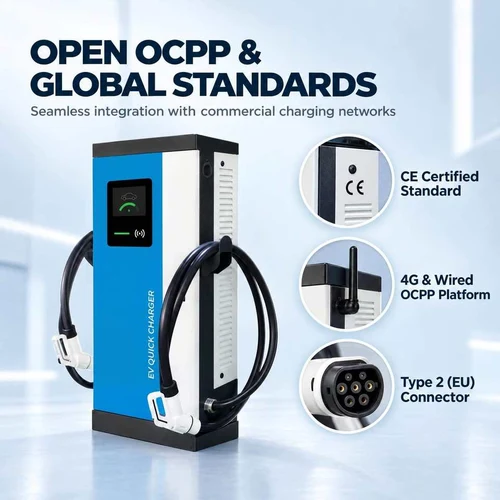
CCS1 vs CCS2 vs GB/T vs CHAdeMO
The connector you specify decides which vehicles can use your charger. Regional standards, not technical superiority, drive the choice — and getting it wrong is expensive to undo.
Key takeaways
- Connector choice follows the vehicle population of the country, not the charger specification.
- CCS2 is the dominant DC standard across Europe, the UK, Australia/New Zealand, India and much of Southeast Asia.
- CCS1 covers North America and Korea; GB/T is the Chinese DC standard; CHAdeMO remains largely Japanese-brand legacy.
- Public sites in mixed markets are usually specified with two gun types rather than one.
- BESTAR DC chargers are configurable with CCS1, CCS2, GB/T and CHAdeMO gun options.
Where each standard is used
The map is remarkably stable — these are regional decisions made by regulators and vehicle makers.
CCS2 (derived from the Type 2 AC connector) is the DC standard across Europe and the UK, and has been adopted in Australia, New Zealand, India, Thailand and a growing list of other markets.
CCS1 (derived from Type 1) is used in North America and Korea. GB/T is the Chinese national DC standard and is what vehicles sold in China use.
CHAdeMO originated in Japan and is fitted to Japanese-brand vehicles; newer Japanese models sold in Europe and North America have largely moved to CCS.
Power levels in practice
The standards overlap heavily on power; the limiting factor is usually the vehicle and the site, not the connector.
CCS2 installations in Europe commonly run from 50 kW up to 350 kW and above on highway corridors.
GB/T DC and CHAdeMO have historically been associated with lower power levels, which is one reason highway operators in those markets have migrated to CCS.
Above roughly 150 A, cables are usually cooled — at that point the cable, not the connector, sets the practical current limit.
Specifying for a mixed fleet
Most real sites serve more than one vehicle generation, especially in fleets that import vehicles.
Dual-gun chargers — one CCS2 and one CHAdeMO, or two CCS2 — are the common answer for public and fleet sites during the transition.
Where the vehicle mix is uncertain, specify the charger with a swappable gun or a second gun rather than committing the whole cabinet to one standard.
How to choose
Decide by market first, then by vehicle mix, then by growth.
Frequently asked questions
Can one charger support more than one connector?
Yes. A single DC cabinet can be built with two guns of the same or different standards; the guns are selected at order time because they change the cable and the cooling arrangement.
Is CCS2 replacing CHAdeMO in Europe?
For new installations, effectively yes: European regulation and vehicle makers have converged on CCS2 for DC. CHAdeMO remains relevant only where older Japanese vehicles are still in service.
What about NACS in North America?
NACS is being adopted by a growing number of North American vehicle makers. If your site is in that market, confirm the connector with us at order time, as the situation is moving.
Do AC wallboxes have the same regional split?
Type 1 and Type 2 also split by region, but AC charging is frequently handled with a socket or a tethered cable matched to the local vehicle population, which makes it easier to change later.
Can the gun be changed after installation?
Sometimes, but it is not a small job: the cable, its cooling and the connector locking are all built into the dispenser. Specify the guns you need up front wherever possible.
Which standards can BESTAR build?
CCS1, CCS2, GB/T and CHAdeMO across the DC range, with single or dual gun configurations. Send us your market and vehicle mix and we will specify the combination.
Related products
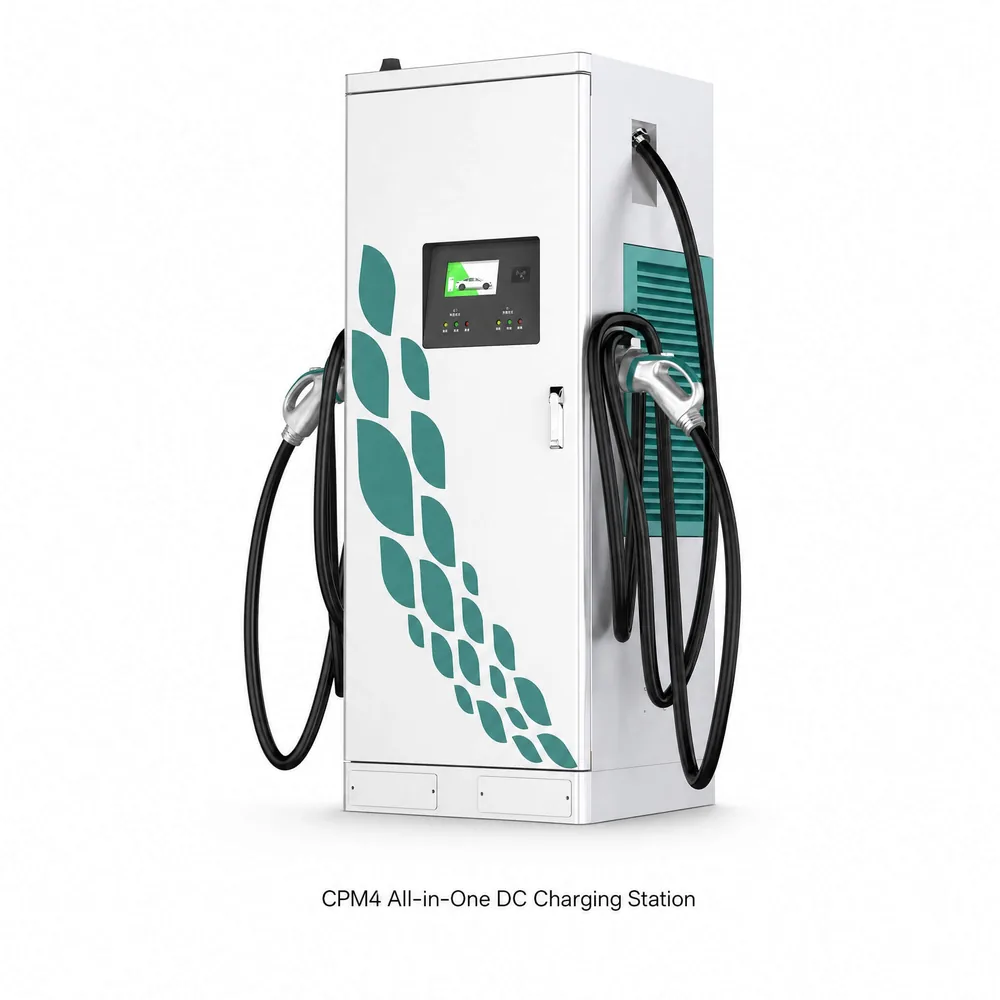
DC Fast Charging Station 60-160 kW
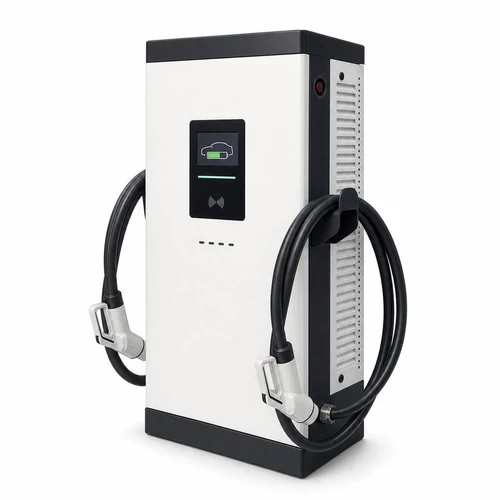
Floor-Standing Dual Gun DC Charger 60-120 kW (ZT120)